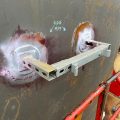
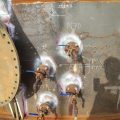

Liquid Penetrant Testing (PT) is a surface inspection method used to identify discontinuities that are open to the surface of non-porous materials. It is commonly applied to welded joints and machined components where surface integrity is critical.
The process relies on capillary action, where a liquid penetrant is drawn into surface-breaking defects. After a specified dwell time, excess penetrant is removed and a developer is applied to draw out indications, making defects visible under normal or UV light.
Applications
PT is typically used for:
Standards & Control
All PT inspections are performed in accordance with applicable international standards, approved Inspection Test Plans (ITPs), and client-specific requirements, ensuring consistency, reliability, and full traceability of results.
Purpose
The purpose of Liquid Penetrant Testing is to reliably detect surface-breaking discontinuities that may affect the performance, safety, or service life of welded structures and components.
Welding Qualification & Inspection
Independent welding inspection and testing services.
Fabrication Workshops
Construction Sites
Industrial Projects
Contact WQI directly for welding inspection, procedure qualification, certification support, and non-destructive testing requirements.